
Axle Weights for Trucks: Federal Limits and Bridge Formula
Axle weight is the share of a loaded truck’s weight that presses down through one axle or a group of axles. For anyone running a fleet, the axle weight decides what you can load, how you load it, and whether your trucks roll or get stopped at the scale.
What Is Axle Weight?
Axle weight is how much of a truck’s total loaded weight rests on one axle or on a set of consecutive axles. Regulators limit it separately from gross weight because a truck can sit under the 80,000-pound gross cap and still carry too much on one axle or tandem.
Gross weight measures the whole rig. Axle weight measures the pressure at each point where the truck meets the road. A load has to pass both to be legal.
Axle Weight vs. Gross Vehicle Weight
Gross vehicle weight is the combined weight of the truck tractor, the trailer, and the cargo. It is the number a scale reads when the full vehicle drives across it.
Axle weight is the portion of that total carried by a single axle or an axle group. A trailer loaded heavy toward the rear can keep the total gross weight legal while overloading the trailer axles. This is why fleets check both figures before dispatch.
Types of Truck Axles
Trucks carry weight on several axle types, and federal rules group them by how the axles are spaced. Each type plays a different role in a legal load.
- Steer axle: front axle under the truck tractor, and it carries the cab and engine.
- Single axle: one axle on its own, or a set of axles whose centers sit within 40 inches of each other.
- Tandem axle: two consecutive axles spaced more than 40 inches apart but no more than 96 inches apart.
- Tridem or axle group: three or more consecutive axles working together.
The rear axle and trailer axles fall into these same categories depending on how they are spaced.

Federal Axle Weight Limits for Trucks
Federal law sets three main weight limits for commercial vehicles on the interstate system. A single axle can carry up to 20,000 pounds, a tandem axle up to 34,000 pounds, and the full vehicle up to 80,000 pounds of gross weight unless the bridge formula sets a lower number.
These limits come from Title 23 of the United States Code and are enforced under federal regulation. Read the federal weight rule in 23 CFR 658.17.
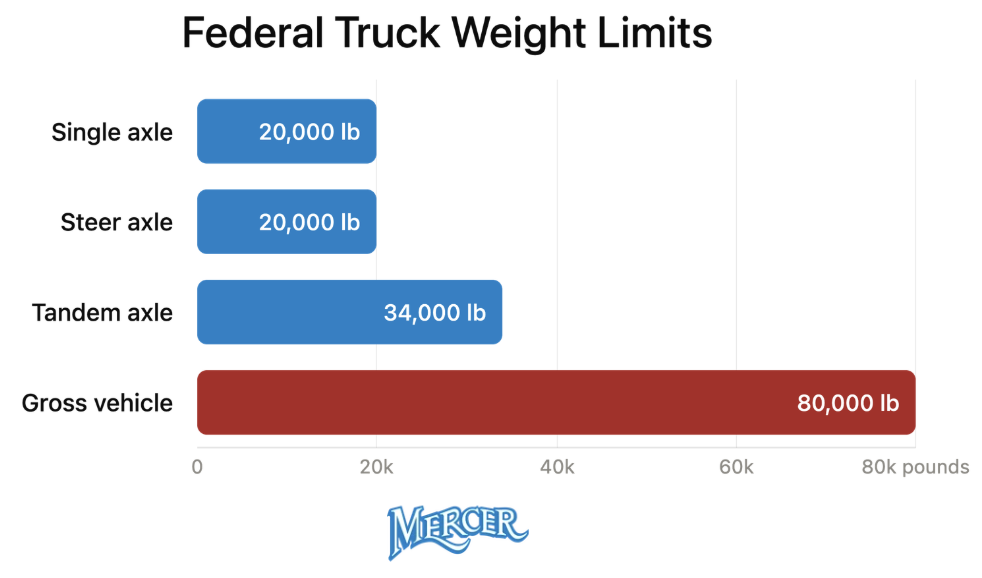
These are the maximum weight figures a state may not drop below on the interstate system. Some state highways use different limits, which the state section below explains.
Steering Axle and Tire Size Limits
Federal rules also protect the steering axle and set a floor for tire loads. A state cannot enforce a steer axle limit below 20,000 pounds or below the axle rating set by the manufacturer, whichever is lower.
Tire size affects the picture too. States may not limit tire loads to less than 500 pounds per inch of tire width, and that tire rule does not apply to the steering axle. Wider tires spread the load and support more weight within the same axle limit.
What Is the Federal Bridge Formula?
The federal bridge formula sets the maximum weight allowed on any group of two or more consecutive axles based on the number of axles and the distance between the outer ones. Loads packed into a short wheelbase get a lower legal weight than the same load spread across a longer one.
The formula exists so that a truck’s weight does not concentrate on a small stretch of a bridge. Two trucks can weigh the same, yet the shorter one presses harder on the structure below it.
The Bridge Formula Equation
The bridge formula is written as W = 500 [ (L × N) / (N − 1) + 12N + 36 ].
The number 500 and the added values keep the result tied to real bridge-loading limits rather than raw axle count. The formula rewards spreading a load out: as the distance between the outer axles grows, the allowable weight climbs, and as axles bunch together, it drops.
The three variables below are what you plug in to run it for any axle group.

How to Calculate Axle Group Weight
To find the legal weight for an axle group, run the numbers through the formula step by step. Here is how it works for a standard five-axle tractor-trailer with about 51 feet between its outer axles.
- Multiply L by N: 51 × 5 = 255.
- Divide by N minus 1: 255 ÷ 4 = 63.75.
- Add 12 times N: 63.75 + 60 = 123.75.
- Add 36: 123.75 + 36 = 159.75.
- Multiply by 500: 159.75 × 500 = 79,875 pounds.
That result sits just under the 80,000-pound gross limit, which is why a common five-axle configuration needs roughly 51 feet of axle spacing to load to the maximum. A shorter wheelbase lowers the maximum legal weight even when every single axle and tandem looks fine on its own.
The Two-Tandem Exception
Federal law includes one exception that lets a standard semi reach full weight. Two consecutive tandem axle sets may each carry 34,000 pounds as long as the first and last axles of the two tandems sit at least 36 feet apart.
This exception is what allows a five-axle tractor-trailer to haul 80,000 pounds legally. Without it, the bridge formula would hold many common rigs below the gross limit.
Why Axle Weight Limits Exist
Axle weight limits exist to protect bridges and pavement from the stress that heavy trucks place on them. Weight concentrated over a short distance wears a structure faster than the same weight spread across more axles and more length.
The federal government set axle and gross weight limits for the Interstate System in 1956, then enacted the bridge formula through the Federal-Aid Highway Amendments of 1974. Some states kept stricter limits that were already in place, which still shape the rules today.
What Happens If a Truck Is Over the Axle Weight Limit
An overweight truck faces fines at the scale and can be held out of service until the driver brings the load into compliance. The overage also follows the carrier, since weight violations show up in inspection and compliance records.
The cost goes beyond the ticket. Overloaded axles create real problems on the road:
- Fines rise with the size of the overage and vary from state to state.
- Weight enforcement happens at fixed weigh stations and with portable scales on the roadside.
- Extra weight wears tires and brakes faster and lengthens the distance a truck needs to stop.
- A carrier can be held liable for damage to bridges and roads caused by an illegal load.
Staying legal keeps trucks moving, protects the equipment, and supports the safety record that customers count on.
How to Keep Your Trucks Within Axle Weight Limits
The two habits that keep trucks legal are spreading the load correctly and weighing it before the truck leaves. Most weight problems trace back to how the freight sits on the trailer, not to how much it weighs.
Balance Your Weight Distribution
Good weight distribution moves load off any axle that is carrying too much. Drivers have a few ways to adjust it:
- Slide the trailer tandems forward or back to shift weight between the drive axles and the trailer axles.
- Adjust the fifth wheel to move weight between the steer axle and the drive axles.
- Place the heaviest freight over the axle groups built to carry it rather than between them.
Small changes to a sliding tandem can move well over a thousand pounds between axle groups, which is often enough to bring a borderline load into compliance.
Weigh Every Load Before You Dispatch
Weighing a load before dispatch is the surest way to catch a problem while you can still fix it. Drivers can use a certified public scale, such as a CAT scale, or an onboard scale built into the truck.
Reweigh after any adjustment. Sliding the tandems changes the weight on more than one axle group, so a second pass across the scale confirms the truck is legal before it reaches the highway.
Overweight Permits and Non-Divisible Loads
When a load cannot be broken down and still goes over the legal limits, you move it under an overweight permit issued by each state on the route. These permits cover non-divisible loads, meaning freight that would lose its value or use if you split it into smaller pieces.
Permit options depend on how often you haul the load:
- A single-trip permit covers one move on a set route and date.
- An annual permit covers repeated moves of similar loads over a year.
- Permit conditions can require an alternate route, set travel hours, or call for escort vehicles.
Moving an overweight load legally takes planning across every state line, which is where an experienced carrier earns its place. Mercer Transportation handles this work through its heavy haul trucking and equipment hauling services.
Haul Your Oversized Freight With Mercer
Loads that run over standard weight or dimension limits need the right permits, routing, and equipment, and Mercer moves them every day. Explore our heavy-haul shipping services to get an overweight load where it needs to go, legally.
State vs. Federal Axle Weight Limits
Federal axle weight limits apply to the Interstate System, while each state sets its own limits on state highways. A state cannot enforce limits below the federal figures on interstate routes. State roads can follow different rules, though, and some states grandfathered higher limits that predate the 1956 federal standards.
Always confirm the limits for every state a load will cross before you build the route. A configuration that is legal in one state can run over the limit in the next, and the safest plan accounts for the strictest rule on the trip.
Move Overweight and Heavy Freight with Mercer Transportation
Mercer Transportation moves heavy, oversize, and overweight freight multiple times a day. Plus, we handle the permitting, routing, and equipment that keep each load compliant. Any load over 55,000 pounds counts as heavy haul, and Mercer Transportation has the specialized trailers and experienced owner-operators to carry it safely.
For overweight and oversize loads, we run lowboy, removable gooseneck, double drop, and step deck trailers. Our team plans the route and pulls the permits so your freight travels within the law. Learn more about our freight solutions and freight management services that support fleets and shippers across the country.
Ready to move a heavy or overweight load? Request a free quote from Mercer Transportation or call 502-584-2301 to talk through your shipment with a team that knows the rules of the road.