
How to Ship Cranes: A Guide to Crane Transportation and Heavy Hauling
Transporting a crane is not the same as moving standard construction equipment. Cranes are among the largest and heaviest machines used in the construction industry. Their long booms, counterweights, and structural components require careful planning, specialized trailers, permits, and experienced heavy haul support to move safely.
Because of this, companies looking for crane transportation often find themselves managing multiple moving parts, including disassembly, load securement, escort vehicles, oversize load permitting, and coordination at both the pickup and final destination.
Below, we’ll break down the entire crane transport process so you know what to expect before the move begins.
Why Crane Transportation Requires Specialized Experience
Cranes vary significantly in size, weight, and structural configuration. A mobile crane may weigh less than 100,000 lbs, while crawler cranes or large tower cranes can weigh several hundred thousand lbs once fully assembled. The shape of a crane also introduces added complexity. Long boom sections, tall upperworks, and wide undercarriages influence trailer selection and route planning.
Several challenges make crane hauling different from ordinary construction equipment movement:
- Loads are often classified as oversized loads.
- Many cranes require disassembly before transport.
- Special trailers are required to distribute weight correctly.
- Roads, bridges, and jobsite access points must be reviewed in advance.
- Oversized load transportation often requires pilot cars, signage, and restricted travel windows.
This is not a part of freight management solutions where cutting corners works. Crane transport benefits from structured planning, experienced drivers, and a carrier with the capacity and knowledge to handle oversized load transportation safely.
Types of Cranes Commonly Transported
Companies move cranes for construction, manufacturing, energy infrastructure, port operations, real estate development, and more. The most common crane types transported include:
- Mobile Crane: Self-propelled crane used widely on job sites across the United States. Often moved with limited disassembly.
- Crawler Crane: Equipped with tracked undercarriages. Typically require removal of counterweights and boom sections before transport due to weight.
- Tower Cranes: Frequently used in urban real estate construction. Transported in multiple truckloads, with each section shipped separately.
- Carry Deck Cranes: Smaller, more compact cranes often moved as a single unit.
- Truck-Mounted Cranes / Crane Trucks: These are mobile cranes mounted directly to commercial truck chassis and can travel on public highways.
Each crane is transported based on its weight, length, boom configuration, and current condition at the job site.
Do Cranes Need to Be Disassembled Before Transport?
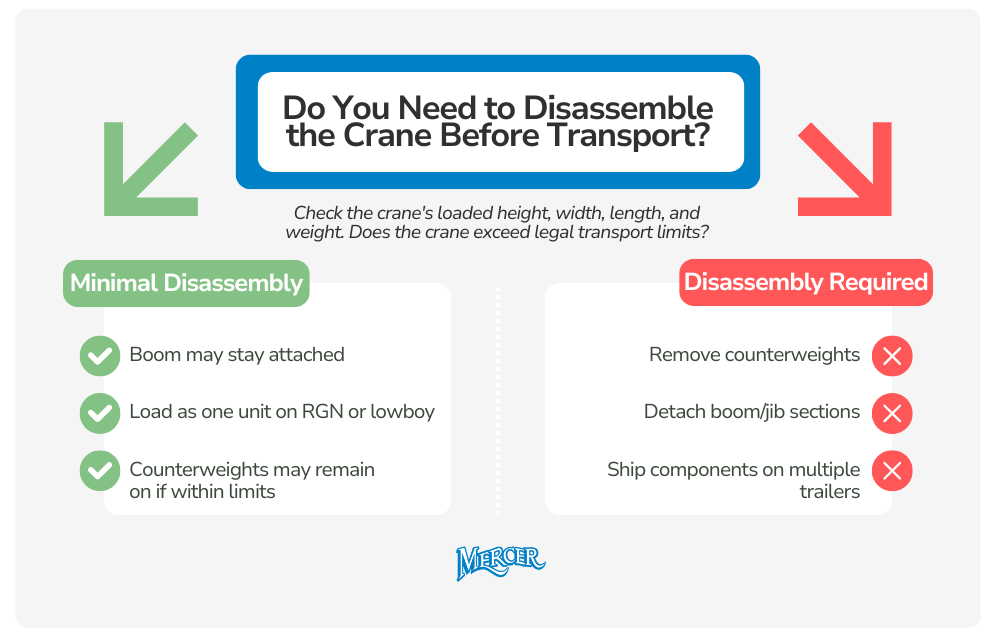
In many cases, yes — but the amount of disassembly varies. Most cranes are not transported fully assembled, particularly crawler cranes and large mobile cranes. Disassembly reduces load size and weight so the crane can move legally under state oversize load limitations.
Typical pre-transport disassembly steps include:
- Removing Counterweights: Counterweights are heavy and often need to travel in separate loads to achieve compliant axle weight distribution.
- Detaching Booms and Jibs: Long boom sections generally move on flatbed or extendable trailers.
- Securing Pins and Hardware: Loose hardware must be stored and documented to prevent loss or damage.
Disassembly should follow manufacturer guidance. It is also common to have a second crane on-site to support lifting components during the breakdown process.
Trucks and Trailers Used for Crane Transportation
The type of trailer used depends on crane weight, length, transport distance, and state regulations. Here is a quick overview:
| Trailer Type | Best Used For | Advantages |
|---|---|---|
| Flatbed | Boom sections, jibs, attachments | Open deck flexibility and easy loading |
| Lowboy | Crane upper assemblies / heavy crane bodies | Lower center of gravity for tall or heavy cargo |
| RGN (Removable Gooseneck) | Rolling self-propelled cranes onto the trailer | Allows equipment to be driven on rather than lifted |
| Extendable Trailer | Long boom pieces that exceed standard deck lengths | Prevents unsafe overhang and reduces oversize length flags |
| Multi-Axle Heavy Haul Configurations | Crawler base, large crane assemblies | Distributes weight across multiple axles to meet state limitations |
Choosing the correct trailer is a primary part of safe crane transport. Selecting the wrong one can cause road delays, re-routing, and overweight penalties.
Let Mercer Handle Your Crane Transport
From trailer selection to route coordination and permitting, our team manages the full process so your crane reaches the jobsite ready for work.
What Permits Are Needed to Ship a Crane?
Because most cranes meet the definition of oversized loads, they cannot move on public highways without permits. Each state’s transportation department reviews and issues permits, and the requirements can vary widely. However, crane transportation services generally have to account for:
- Width: Loads wider than 8 ft 6 in require oversize permits.
- Height: Loads over 13 ft 6 in typically require route review for low bridges and overhead utilities; some states allow up to 14 ft before additional review.
- Length: Standard trailer length limits vary, but boom sections or assembled crane carriers that exceed 53–65 ft usually require overlength permitting.
- Weight: Loads exceeding 80,000 lbs gross vehicle weight require overweight permits. It’s common for crane bodies to exceed this threshold, requiring multi-axle heavy haul trailers.
Permit and Escort Requirements
Depending on dimensions and route, the following may be required:
| Load Condition | Escort / Pilot Car Requirement (Typical) |
|---|---|
| Over 12 ft wide | 1 pilot car in most states |
| Over 14–16 ft wide | 2 pilot cars (front and rear) |
| Over 100 ft long | Pilot car and/or law enforcement escort may be required |
| Travel at night | Often restricted or requires special permission |
Some states also limit crane travel during:
- Major commuter traffic windows
- Certain weather conditions
- Holidays and weekends
- Mountain or coastal seasonal closures
Route Planning and Road Surveys
Before permits are approved, routing software and field checks help verify:
- Bridge weight limits
- Turning radii in urban intersections
- Road shoulder clearance
- Overhead wires or traffic signals
- Slope and grade concerns in hilly terrain
These are not theoretical considerations. A boom or crawler body routed down the wrong road can get stuck under an overpass or unable to make a required turn. Carrier experience matters here. A carrier with years of experience will have established permit processes that avoid delays and unnecessary backtracking.
Preparing a Crane for Transportation
Before any crane transport begins, preparation should be completed:
- Confirm disassembly steps at the pickup location
- Inspect equipment for damage or maintenance needs
- Secure components with blocking, cribbing, and dunnage
- Verify loading area surface stability for safe lifting
- Record measurements and weights for accurate permit filings
Good preparation prevents problems during transport, unloading, and reassembly.
How Long Does Crane Transportation Take?
Crane transportation time varies, and several factors influence total project duration:
- Distance between locations
- Permit processing time (varies by state)
- Amount of disassembly
- Weather restrictions
- Road construction detours
- Crew availability at pickup and final destination
For example:
- Moving a crane locally may take less than a day once loaded.
- Moving a crawler crane across several states may require multiple days due to routing and escort scheduling.
The best approach is to build a strategic plan and timeline upfront to avoid surprises during the move.
How Heavy Is Too Heavy for a Standard Trailer?
Standard flatbed and lowboy trailers have weight limits governed by axle spacing and federal bridge formula guidelines. Most cranes exceed these standard limits in their assembled form. Once a crane reaches a certain weight threshold, multi-axle heavy hauling configurations are required to distribute weight legally.
For example:
- A fully assembled crawler crane is too heavy for any single trailer.
- A mobile crane may be driven onto an RGN but still require the boom and counterweights to travel separately.
Understanding weight distribution is a major factor in proper crane hauling.
Can Cranes Be Shipped Internationally?
Yes. Cranes frequently move internationally for oil and gas projects, port expansions, marine terminals, and global construction efforts.
There are two common international shipping scenarios:
- Cross-Border Transport (U.S., Canada, Mexico): Requires customs documentation, proper trailer selection, and familiarity with varied road and permit processes.
- Ocean Transport via Roll-On/Roll-Off or Breakbulk Vessels: Crane components are loaded into cargo holds or secured to the vessel deck.
In all cases, the crane’s dimensions, disassembled configuration, and documentation determine the most cost-effective international movement plan.
Need to move a crane across the U.S.–Canada border? Mercer coordinates permits, documentation, and trailer selection to help your crane move safely between countries.
Don’t Overlook Delivery, Unloading & Jobsite Coordination
The work isn’t finished just because the crane has reached its destination. Safe delivery and unloading depend on how well the jobsite is prepared in advance. Before the crane arrives, it helps to confirm that the ground can support the crane once assembled, coordinate the crews and lifting equipment needed, and review the access paths to make sure trucks and trailers can maneuver into position. Taking care of these details ahead of time helps avoid delays and keeps the setup process moving efficiently once the crane is on-site.
Why Choosing the Right Carrier Matters
Crane transport is not a trial-and-error industry. Mistakes result in delays, damage, and additional permit or re-routing costs. A dependable transportation partner helps prevent these issues. Experience plays a direct role in reducing problems.
Why Mercer Transportation Is a Trusted Partner for Crane Transport
Mercer Transportation provides crane transport services across the country with decades of experience handling full truckload, heavy hauling, and oversized load transportation. With more than 1,700 owner-operators and a network that reaches both remote and urban locations, Mercer has the capacity to move cranes of varying sizes and configurations.
Mercer supports customers with:
- Trailer options for booms, crawler bases, and mobile crane bodies
- Permit coordination and route review
- Service offerings aligned to construction equipment and heavy equipment hauling needs
- A long history of safety and on-time delivery performance
When your crane must move from jobsite to jobsite, you want a carrier that has already done this work successfully for years.
Ready to discuss an upcoming crane move? We’re here to help. Let’s talk about your equipment, locations, and schedule, and build a transport plan that fits your project.